What if the right Chinese class in Singapore started with what your child already understands, rather than the level they’re expected to reach? A placement assessment can help identify their current skills and point them towards a suitable starting level.
It’s understandable to want more than a guess based on age or school year. A useful assessment considers your child’s existing Chinese proficiency so the course can meet their learning needs.
This guide explains how assessments for children can work and how to compare age-based programmes, course levels, prerequisites and certificates. You’ll also learn what to consider when comparing course fees, so you can make an informed choice for your child.
Key Takeaways
- Use your child’s current Chinese skills, not age alone, as a starting point for choosing a suitable course level.
- Compare age-based programmes by learning goals, prerequisites and the skills each level develops.
- For non-native learners, the HSK framework has six levels, from Level 1 to Level 6.
- A listed weekday online Chinese Level 1 class meets on Mondays and Wednesdays from 7.30pm to 9pm.
- Allow one hour for the Chinese Level 4 placement test as you consider assessment and certificate requirements.
Beginner Chinese communication skills
For beginners, everyday Mandarin starts with practical exchanges, not memorising long vocabulary lists. A learner might practise greeting someone, introducing themselves, asking a simple question and understanding a short reply. These tasks build communication skills for familiar situations, such as meeting a neighbour or ordering a drink. A beginner Putonghua class can focus on clear pronunciation, listening and spoken participation. Putonghua is the standard spoken form commonly taught in Mandarin classes.
Beginner Chinese lessons are easier to follow when each activity has a clear purpose. A teacher can introduce a short dialogue, model its sounds, then invite learners to practise in pairs. For example, one learner asks for a drink while the other responds and confirms the choice. Repeating the dialogue helps learners notice unfamiliar sounds and recall useful words. It also gives the teacher a chance to hear which parts need more practice.
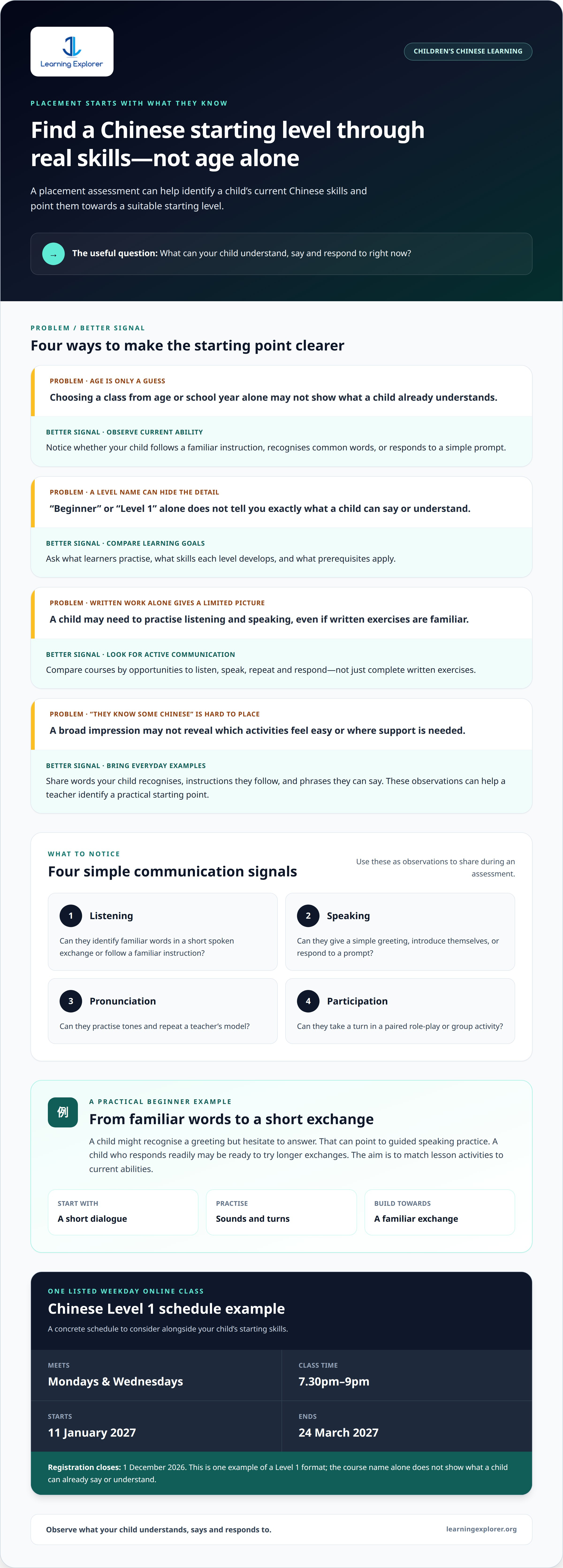
- Listening: Identify familiar words in a short spoken exchange.
- Speaking: Give a simple greeting or introduce yourself.
- Pronunciation: Practise tones and repeat a teacher’s model.
- Participation: Take a turn in a paired role-play or group activity.
For children, a useful first assessment looks at what they understand and can express, rather than relying on age alone. A teacher can observe whether a child follows a familiar instruction, recognises common words or responds to a simple prompt. A child who understands a greeting but hesitates to answer may need more guided speaking practice. One who responds readily may be ready for longer exchanges. These observations help match lesson activities to current abilities.
Families can compare beginner courses by checking what learners practise in class. Look for opportunities to listen, speak, repeat and respond, rather than lessons focused only on written exercises. For instance, a picture prompt can help a child name an everyday object and use it in a short sentence. Ask how the course introduces new sounds and encourages participation, especially if the learner feels shy speaking aloud.
One listed weekday online Chinese Level 1 class meets every Monday and Wednesday from 7.30pm to 9pm. It starts on 11 January 2027, registration closes on 1 December 2026, and it ends on 24 March 2027. This schedule gives families concrete dates to consider when planning beginner lessons. The class is one example of a Level 1 format; course names alone do not show exactly what a child can already say or understand.
Before choosing a starting level, note a few real examples of your child’s Mandarin: words they recognise, instructions they follow and phrases they can say. Share these observations during an assessment. A teacher can use them to identify a practical starting point and plan suitable speaking and listening activities. This makes the first step more focused: helping the learner take part in a simple exchange with growing independence.
Chinese as a foreign language for non-native speakers
For non-native speakers, learning Chinese can start with practical goals: following a short conversation, asking for directions or introducing yourself. A useful course connects new vocabulary to familiar situations. For example, someone new to Singapore might practise asking a colleague to repeat a meeting time. Speaking practice, listening exercises and clear pronunciation work together; studying vocabulary alone may not prepare someone to respond naturally.
Progressive language proficiency levels offer a way to organise learning from introductory skills to more advanced communication. Exam levels can offer learners a way to understand progression from introductory to more advanced study. This scale can help learners understand a progression of study, but a level label alone doesn’t explain every learner’s speaking, listening, reading, or writing ability. Course placement should also consider the learner’s current skills and goals.
Workplace learning benefits from examples tied to situations learners actually face. In Mandarin-language workplace safety training, a language lesson might practise recognising a supervisor’s instruction, asking for clarification or repeating a simple direction. These exercises focus on communication in Mandarin. They are not a substitute for workplace safety instruction or training on specific procedures. Clear learning objectives help distinguish language practice from operational guidance.
Tourist guide training can take a similar approach, with practice shaped around visitor interactions in Singapore. A learner might explain where to meet a group, answer a question about a nearby landmark or give a short direction. In a Mandarin-language lesson, these scenarios build speaking confidence and useful vocabulary. They also help instructors notice whether learners understand questions, respond clearly and keep an exchange moving.
- Starter practice: Use greetings, introductions, and simple requests.
- Developing practice: Build short exchanges around workplace or visitor scenarios.
- Progressive practice: Add detail, clarification, and longer responses as skills grow.
Choose learning activities based on the communication task, not just a level name. Someone preparing for workplace conversations may need to practise asking for clarification. A future guide may need to describe a route and respond to visitor questions. For either learner, a teacher can use role-play, listening prompts and feedback to target specific gaps. This gives each practice exchange a purpose and connects it to a real communication goal.
For a learner who wants guided speaking practice beyond workplace or visitor scenarios, explore Mandarin learning options. A clear goal, such as holding a short conversation or handling a familiar question, can help shape a relevant learning pathway without confusing language proficiency with job-specific training.
Chinese course levels and prerequisites
In Singapore, Chinese language schools and private tutors offer different learning formats, from structured classes to individual lessons. Compare their course levels, schedules, and teaching approach against the learner’s goals.
When choosing a Chinese teacher or tutor, look for strong Mandarin proficiency, relevant teaching experience and the ability to explain concepts clearly. A teacher should be able to adapt examples for beginners and learners with prior experience.
Course levels help organise learning, but the same level label can cover different skills. A Level 1 course may suit a learner starting from basic phrases, while Level 2 generally calls for some prior learning. Treat those descriptions as a guide, not a substitute for placement. A short assessment can explore what the learner understands, says, reads, and writes before a level is chosen.
Adult Mandarin courses in Singapore may focus on everyday conversation or workplace communication. An adult learning for travel, for example, may prioritise asking for directions and understanding replies. Someone preparing for work may need to practise introducing a topic or clarifying a point in a meeting. Match the course goal to the situations where the learner wants to build confidence.
Course fees depend on factors such as course length, lesson frequency, class format, and learning materials. Compare what each course covers alongside its schedule, rather than using the level name alone to judge value. A longer course may give learners more opportunities to practise, while a more frequent schedule can shape how they fit lessons around work and family commitments.
Listed 2027 schedules offer concrete examples for planning. The weekday Chinese Level 2 course starts on 12 January and ends on 18 March. The Saturday Chinese Level 1 course starts on 9 January and ends on 20 March. These start and end dates help learners consider whether a course fits their calendar.
The Saturday Chinese Level 2 course meets from 2pm to 5pm every Saturday for 10 weeks. That schedule provides a consistent weekly block, while the weekday Level 2 dates show a different course pattern. Check the stated meeting times and course dates against work, family, or school commitments before choosing.
- Before placement: Note prior Mandarin study and the skills the learner wants to build.
- When comparing courses: Match the stated level and learning focus to those skills.
- Before enrolling: Review the course dates, weekly schedule, format, and fee structure.
For a beginner, a course that builds from familiar phrases can make the next step clearer. For someone with prior experience, a starting level based on current skills can help avoid repeating material or moving ahead too quickly. Use the course prerequisites and learning goals to make an informed choice.
Assessment and certificate requirements
A placement assessment helps identify a suitable starting level, while a certificate records a defined course or exam outcome. They serve different purposes. A learner, for example, may take an assessment before lessons, then pursue a certificate through a separate examination. Before enrolling, find out what each assessment measures and what the resulting document represents.
Enrolment involves choosing a course, selecting a level and schedule, then completing registration. A placement test helps determine the starting level; a trial lesson is a separate way to experience a class. Availability of a trial lesson depends on the course’s enrolment arrangements, so don’t treat it as part of a placement assessment.
A placement test can examine several skills rather than relying on a learner’s age or confidence alone. It may include listening to spoken Mandarin, responding to a prompt, reading familiar text, or writing basic characters. The Chinese Level 4 placement test lasts one hour. That gives learners a concrete example of the time involved in this particular assessment, not a standard duration for every placement test.
For children, an assessment can focus on practical evidence of current ability. A teacher might ask the child to follow a short instruction, describe a familiar object or read a simple sentence. These tasks show different parts of a Chinese foundation. A child who recognises written words but struggles to speak may need a different starting point from a child who speaks readily but cannot read the same text.
Certificates also depend on the route taken. A course completion certificate and an external language exam certificate are not interchangeable. Before enrolling, identify the assessment body, the skills tested, and whether the certificate records attendance, course completion, or exam performance. For example, someone seeking a structured proficiency measure may consider the HSK examination, which has six levels from Level 1 to Level 6.
Exam format can help learners understand the preparation involved. The HSK Level 1 and Level 2 exams each have 30 questions. The HSK final-level exam has 90 questions. Those figures describe question counts, not the number of skills assessed or a guarantee of a particular result. Preparation should match the learner’s current level and the examination’s stated format.
- Before enrolment: Choose a course goal, level, format, and schedule.
- During placement: Use listening, speaking, reading, or writing evidence to guide level choice.
- Before pursuing a certificate: Confirm what the assessment measures and what the document records.
A clear assessment supports active learning by showing which skills need attention next. For example, feedback on listening and pronunciation can help a learner build a stronger foundation before tackling longer conversations. Keep the certificate’s purpose in view: choose a course assessment to track learning progress, or an exam route when an external proficiency measure is the goal.
Chinese tuition and enrichment programmes by age and school level
No single tuition centre suits every student in Singapore. Compare programmes by age suitability, starting proficiency, lesson focus and how teachers give feedback, rather than by centre name alone.
Match a Chinese class to the learner’s age, current ability and goal. A younger beginner, for example, may benefit from picture prompts and spoken vocabulary, while a student preparing for schoolwork may need reading and writing practice.
Age can guide the teaching style, but it doesn’t show proficiency by itself. A child who understands Mandarin at home may speak comfortably yet need support reading characters. Another student may recognise written vocabulary but hesitate during conversation. A placement activity can reveal these differences and help identify a suitable course level.
For younger learners, short exchanges about familiar topics can make lessons more accessible. A teacher might use a picture of food to practise naming items, asking what someone likes and answering with a complete phrase. As students develop, lessons can include longer spoken responses, reading passages and writing tasks. The right balance depends on the learner’s existing skills and purpose.
School level matters because students may have different priorities. One learner may want to improve everyday conversation, while another needs support with Chinese reading or classroom tasks. Enrichment should provide practice suited to the student’s needs, not simply repeat familiar exercises. For example, a student who already reads confidently may benefit more from discussion than another worksheet.
Compare tuition and enrichment programmes using the same practical criteria. Check whether the course includes spoken participation, vocabulary building, reading, writing or exam-oriented practice. Consider whether lessons are individual or group-based, and whether the format suits the student’s attention and confidence. These details make comparisons more useful than broad claims that a centre suits all ages.
- For a beginner: Look for clear foundations, familiar vocabulary, and guided speaking.
- For a school-focused learner: Match practice to the student’s reading, writing, and classroom goals.
- For a confident speaker: Choose activities that extend responses and build richer vocabulary.
- For any age: Use current ability and learning goals alongside age when selecting a level.
A student who can follow a conversation but struggles to describe ideas, for instance, may need structured speaking practice. A student who reads well but avoids conversation may need more active participation. These examples show why age, school level and proficiency should be considered together.
Use those priorities to guide the next step: explore Mandarin learning options for structured language practice.
A suitable centre is one whose level and lesson format fit the learner’s age, current Chinese ability and goals. Compare programmes by their balance of speaking, vocabulary, reading, writing and exam practice, and consider whether individual or group lessons suit the student.
Learning Explorer
Learning Explorer helps learners connect their Mandarin goals with a suitable course. If the priority is everyday conversation, the Conversational Mandarin Course focuses on practical communication. For workplace interactions, the Business Mandarin Course offers a business-focused learning direction. Consider the learner’s current ability, preferred setting and the situations they want to handle when deciding which course fits.
A clear starting point can make course choices feel more manageable. Identify whether the learner wants to build confidence in everyday exchanges or communicate more comfortably at work, then use that goal to guide the next step.
Contact Learning Explorer to discuss which Mandarin learning direction suits your goals.
Choose a starting point that keeps learning moving
Your child’s next step doesn’t need to be a perfect long-term plan. Start with one practical goal, such as answering familiar questions, speaking more comfortably or taking part in a short conversation. Use that goal to guide your choice of a Chinese class in Singapore, then revisit it as your child’s skills develop. A clear learning purpose can connect lessons to everyday life.
Learning Explorer offers a Conversational Mandarin Course for practical communication, as well as Conversational English and Business English courses for different language goals. Keeping the goal specific helps you focus on the instruction that fits your needs, rather than choosing a course based on its label alone.
Ready to discuss a suitable direction for your child’s Mandarin learning? Contact Learning Explorer about Chinese classes. A thoughtful next step can help your child approach learning with greater confidence and curiosity.
Frequently Asked Questions
How do you assess my child’s Chinese proficiency?
An assessment considers what your child understands and can express in Chinese. Share examples of where they use Mandarin, such as family conversations or school activities, and what they hope to learn next. A teacher can use that context alongside speaking, listening, reading or writing tasks to identify learning priorities. For instance, a child who understands family instructions may still need support describing ideas independently.
How many students are there in each class?
Class size depends on the lesson format. A private lesson is taught individually, while a group class brings learners together. There isn’t one class size for every Chinese course in Singapore. Consider how your child learns best: a group setting can create opportunities to listen and take turns, while individual instruction can focus closely on one learner’s pace and communication goals.
What’s the difference between Chinese tuition and an enrichment class in Chinese?
Chinese tuition usually focuses on strengthening school-related learning, such as vocabulary, reading comprehension or written expression. Enrichment classes may emphasise broader language use, including speaking practice and cultural topics. The distinction can vary by programme, so compare the lesson objectives. A student who needs help with composition, for example, may benefit from targeted tuition, while one seeking conversation practice may prefer enrichment.
What types of Chinese classes are available in Singapore for children and adults?
Options include beginner lessons, conversational Mandarin courses, school-focused tuition and workplace-oriented classes. Learning Explorer’s Conversational Mandarin Course focuses on practical communication, while the Business Mandarin Course suits professional language goals. Children’s lessons may emphasise age-appropriate participation and foundational skills; adults may prioritise daily conversation or workplace situations. Match the course purpose to the learner’s needs rather than choosing by age alone.
How much do Chinese classes in Singapore cost?
Fees depend on the course language, proficiency level, and duration. For Learning Explorer, the applicable fee is provided after a quote request, rather than as a single figure for every course. Compare the course length, format, and learning materials alongside the fee, since these details shape what the programme includes. This helps families assess the overall fit without relying on an unrelated average price.
Are there beginner, conversational, business Chinese, and HSK preparation classes in Singapore?
Beginner and conversational Mandarin courses serve different starting points and goals. Learning Explorer offers a Conversational Mandarin Course and a Business Mandarin Course. HSK preparation is a distinct exam-focused learning goal: the HSK has six levels, from Level 1 to Level 6. Before choosing an exam-oriented programme, compare its stated syllabus with the level and skills the learner wants to develop.
What are the class schedules, formats, and locations offered by Singapore Chinese language schools?
Schedules and formats vary by course. Learning Explorer offers in-person and online classes, with private and group learning formats. Its training centre is at 10 Anson Road, level 22, International Plaza, Singapore 079903, directly above Tanjong Pagar MRT. Check how a course’s meeting times fit around school, work, or family routines, and choose the format that supports regular participation.
Are there free or subsidised Chinese language courses in Singapore?
Whether a Chinese course is free or subsidised depends on the specific programme and its eligibility conditions. Don’t assume a private language course has a subsidy. For paid classes, compare the stated course fee, duration and learning format. If you’re considering a subsidised option, review its eligibility and coverage before making plans, since terms can differ between programmes.