In Singapore, you can learn Chinese through self-paced study or guided Mandarin courses. The right fit depends on how you prefer to study and practise. If you’re deciding where to learn the Chinese language, look for a clear progression from pronunciation and course levels to practical listening and conversation.
It’s natural to want flexibility without being left to piece together scattered materials. Self-paced learning lets you revisit lessons around your schedule, while a structured course gives you a path to follow and ways to build your understanding step by step.
This article explains what self-paced Chinese lessons can cover, from pronunciation and level progression to practice tools, dialogues, and listening activities. It also shows how these elements support different goals, and how guided Mandarin study can add interaction when you’re ready to practise with others. Understanding the options makes it easier to choose a manageable learning path and make steady progress.
Key Takeaways
- Build clearer pronunciation by learning how pinyin represents sounds and how tones affect meaning.
- Use course levels as a roadmap, choosing lessons that match your current ability and learning goals.
- Make flashcards and quizzes more useful by revisiting challenging words and checking recall regularly.
- Practise with everyday dialogues and listening activities to connect vocabulary with real conversations.
- Self-paced lessons offer flexibility, while guided Mandarin classes can add structured conversation practice.
Chinese pronunciation, pinyin, and tones
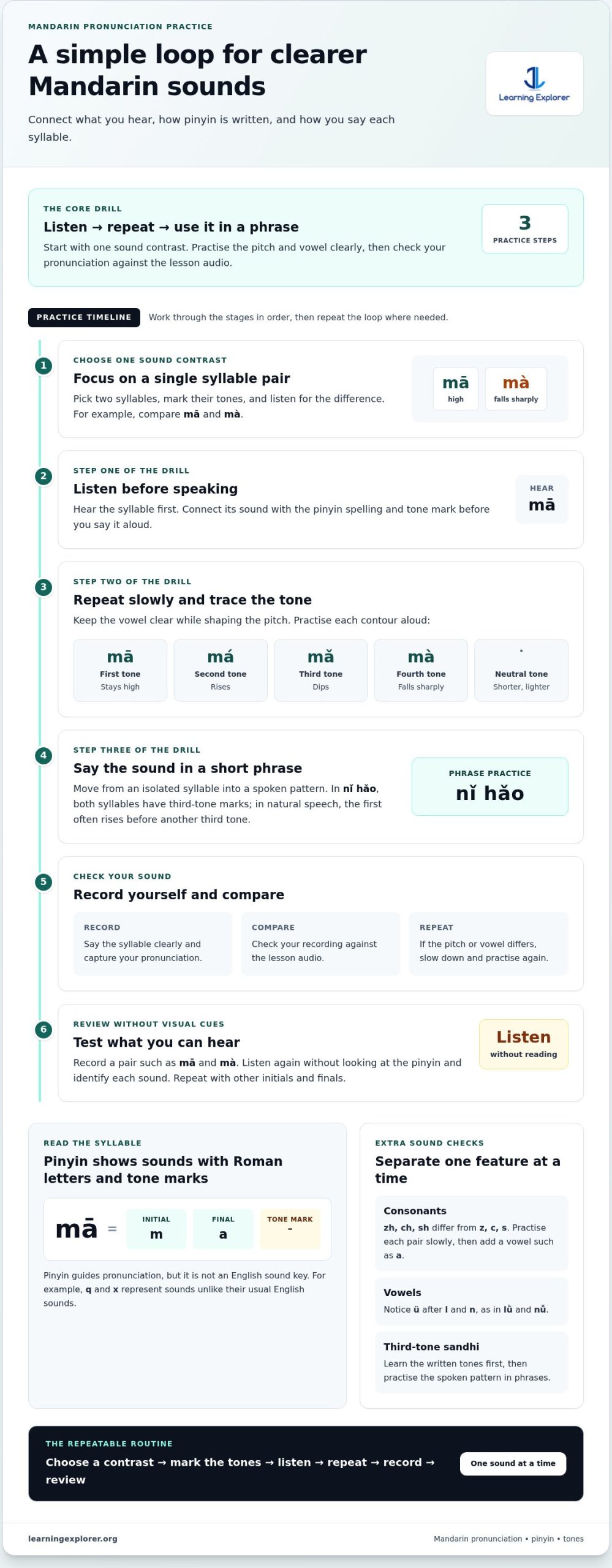
Mandarin pronunciation combines consonants, vowels, and pitch. Pinyin represents these sounds using Roman letters and tone marks. Listen to a syllable before reading it. For example, hear mā, then say it aloud. Connecting the sound, spelling, and voice helps you practise accurately.
A Mandarin syllable can be described in terms of its initial, final, and tone. In mā, m is the initial and a is the final. The tone mark sits above the vowel. Pinyin guides pronunciation, but it isn’t an English sound key. For example, q and x represent sounds unlike their usual English sounds.
To hear Mandarin in a wider context, watch this video:
Mandarin uses four main tones and a neutral tone. Tone can change meaning even when the spelling stays the same. Compare mā, má, mǎ, and mà. The first stays high, the second rises, the third dips, and the fourth falls sharply. A neutral tone is shorter and lighter.
Practise each contour aloud. Hold mā level, then lift má. Let mǎ dip, then finish mà firmly. Keep the vowel clear throughout. Record yourself and compare your pronunciation with the lesson audio. If your pitch or vowel sounds different, slow down and repeat.
Use a three-step drill for each new syllable. First, listen without speaking. Next, repeat slowly while tracing the tone. Finally, say it in a short phrase. In nǐ hǎo, both syllables have third-tone marks. In natural speech, the first often rises before another third tone.
That shift is called third-tone sandhi. Learn the written tones first, then practise the spoken pattern. Tone marks carry meaning, not decoration. Try a minimal-pair exercise: record mā and mà, then identify each without looking. Repeat with other initials and finals to sharpen your recognition.
Pay attention to pinyin spelling contrasts, too. The letters zh, ch, and sh represent different consonants from z, c, and s. Tongue position changes each sound. Practise each pair slowly, then add a vowel such as a. Listen for the difference before increasing your pace.
Vowels need focused attention. Pinyin ü appears after l and n, as in lǜ and nǚ. Keep your lips rounded as you shift your tongue. Record one syllable at a time and compare it with a clear model. Isolating the vowel helps separate it from tone and consonant errors.
Build a routine around one sound contrast. Choose two syllables, mark their tones, listen, repeat, and record. Later, review the recording without reading pinyin. If a sound remains unclear, slow the audio. Isolate its initial, final, or pitch, then practise that part again.
Course levels and learning progression
A useful Mandarin course connects progress to practical tasks. Beginners might start with greetings, names, and simple questions. Later lessons can introduce ordering food or describing routines. Look for clear lesson goals and review points so you can see what each stage builds on.
Progression works best when skills connect. A lesson might introduce family words, then use them in a short dialogue. A later activity could ask you to describe your family. This sequence moves from recognition to use. Choose a course that revisits earlier language in new situations.
Which Chinese courses prepare learners for HSK exams? Choose a Mandarin course with explicit HSK preparation. Look for level-based vocabulary, exam-style listening and reading, and timed practice. A general conversation course can build useful foundations, but exam tasks need targeted preparation.
Where can I learn Mandarin Chinese in Singapore? Options include structured online courses, in-person language classes, and private tutoring. Compare lesson format, progression, speaking practice, and how feedback is provided.
What are the best Chinese language schools and courses in Singapore? The best fit is the one that matches your current ability and goal. Compare beginner support, lesson structure, Mandarin conversation time, and whether the course is aimed at daily use or exam preparation.
Are there Chinese classes at community centres or adult education providers in Singapore? Community centres and adult education providers are places to look for Mandarin classes. Compare the format, focus, and schedule with the learning arrangement that suits you.
Are there beginner Chinese classes for adults in Singapore? Yes. Adults can start with beginner Mandarin classes. Look for lessons that introduce everyday phrases and basic sentence patterns, with guided speaking practice from the start.
What should I look for when choosing a Chinese tutor or school in Singapore? Review the learning plan, instructor feedback, speaking opportunities, and lesson materials. Look for a course that progresses from a first greeting to a practical exchange, such as ordering a drink.
Structured online Chinese courses can make each stage easier to follow. Look for short lessons, audio examples, practice tasks, and clear progress markers. A sample unit on buying food might teach key words, model a conversation, and then test recall. Use that sequence to judge how actively the course engages you.
Set a learning goal before choosing a course. For travel, practise directions and transport questions. For work, focus on introductions and meeting phrases. For HSK preparation, prioritise exam-aligned tasks. The course outline should show how lessons support your chosen outcome.
Try a simple review cycle: learn a phrase, use it aloud, then recall it later. For example, practise “I would like tea” in a café dialogue. Return to it during a later lesson. If you want guided structure, explore structured Mandarin learning options alongside self-paced study.
Flashcards, quizzes, and practice tools
Flashcards help turn Mandarin vocabulary into active recall. Put one Chinese word on each card, with its meaning and a sample phrase. For example, pair 茶 with “tea” and a café sentence. Cover the answer before testing yourself, then say the word aloud before revealing its meaning. This links reading, memory, and speaking. Keep each card focused on one main idea. A whole paragraph can be harder to review.
Build useful sets around situations. A “hawker centre” set could include 饭, 水, and 买. Add an image or short audio clip where available. Test both directions: read Chinese and recall English, then reverse the task. Use a separate card for phrases such as “I’d like rice.” This helps you practise vocabulary in context instead of memorising isolated translations.
Quizzes show which items need more attention. Mix matching, multiple-choice, and typed answers. For 买, first select its meaning, then type the character from memory. Finish by using it in a short sentence. If you get an answer wrong, identify why: was the character unfamiliar, or did the meaning slip? Review that card before adding more new words.
- Recognition: Match 中国 with “China.”
- Recall: Write the character for “water.”
- Listening: Choose the phrase heard in audio.
- Use: Complete a café order with tea.
Choose practice tools that connect these tasks. A digital deck can combine text, audio, and images. A notebook can track troublesome words and example sentences, while a voice recorder can capture spoken answers. After each review, mark cards as easy or difficult and move difficult items into a short review set. Keep it small enough to review attentively, rather than tapping through without recalling the answers.
Use a simple cycle for each new set. First, study the meaning and example. Next, hide the answer and recall it. Then listen and repeat the audio. Finally, use the word in a new phrase. For example, practise 水 in “I’d like water.” At the next review, test your recall before rereading. This gives each tool a distinct purpose.
Keep a mistake log with three columns: word, error, and correction. If you confuse two characters, write both with their separate meanings. If a phrase feels difficult, save its audio for another listening round. End each session by choosing the next review set. A short, deliberate sequence helps you see what you know and what needs more practice.
Real-life dialogues and listening practice
Practise Mandarin through scenes you may encounter in Singapore. A hawker centre exchange could cover ordering, payment, and takeaway. At an MRT station, practise asking which train goes towards City Hall. Give each dialogue a clear purpose, then listen for the words that help complete it.
Start with a short recording and one task. First, listen for the setting. Next, identify familiar words. Then listen again for the speaker’s request. A café conversation, for example, may include tea, price, and size. You don’t need to understand every word immediately. Catching the key detail helps you follow the exchange.
Use a transcript after listening, not before. Read it once, then replay the audio. Mark where the spoken phrase differs from what you expected. In a food-ordering dialogue, listen for the item and quantity. Replay that line, then say it aloud. This connects sound recognition with a spoken response.
- Hawker centre: Listen for a dish, a drink, or takeaway.
- MRT: Catch a station name and direction.
- Shop: Identify a price, size, or colour.
- Work: Follow a greeting and meeting request.
Replay one dialogue in three passes. First, listen without pausing. Second, stop after each sentence. Third, shadow the speaker by repeating each line. For a transport exchange, shadow the question first, then repeat the response. Keep the recording short enough to focus on each phrase.
Real conversations include pauses, reduced sounds, and quick replies. Practise with different speakers when the materials include them. Compare how each person says the same greeting. Don’t rely only on clean, isolated words. A familiar phrase can sound different in a sentence, especially when speakers connect words naturally.
Prepare repair phrases for moments of uncertainty. Practise asking someone to repeat or speak more slowly. Use a dialogue where one speaker misses a station name. Pause the audio, say the repair phrase, then resume. This gives listening a practical purpose and helps you stay engaged when you miss a detail.
After each session, track your listening with a simple note. Write down the scene, key words heard, and one phrase to revisit. For example: “shop, size and price, replay the question.” In your next practice round, listen without the transcript. Check whether you can identify the same details independently.
Finish by changing one detail in the dialogue. Replace tea with coffee, or City Hall with another station. Replay the original, then speak the adjusted version. This tests whether you understand the exchange rather than simply memorising its sound. Use the same method with food orders, greetings, and workplace requests.
Self-paced lessons without live tutoring
Self-paced Mandarin study gives you control over when you learn. A clear routine can keep your lessons connected and practical.
Self-Paced Video Lessons
Choose video lessons with one clear learning goal. A lesson might introduce phrases for a taxi ride. Watch once to understand the situation, then replay key lines. Pause to repeat each phrase aloud. Check whether captions, transcripts, and audio controls make review easier. Short, focused videos let you revisit a phrase without restarting the whole course. After watching, try saying the phrase from memory.
Choosing a Learning Format
Group classes offer shared activities and peer conversation. Private tutoring can focus on your personal goals and errors, while online lessons suit learners who need flexible access. Compare how much speaking practice, feedback, and structure each format provides. Choose group learning for turn-taking, individual sessions for targeted support, or self-paced online study for independent review and control over your schedule.
How do I choose between group classes, private tutoring, and online lessons? Match the format to your priority: group practice, individual feedback, or flexible independent study. Consider your weekly schedule and how much guided speaking you need.
Build a study schedule around a repeatable sequence. Pick a regular study slot that fits your routine in Singapore. Begin with one video lesson, then review its phrases. Use a notebook to record new words and questions. Finish by speaking a short response without reading. For example, answer “Where are you going?” with a destination you know. Follow the same sequence each session.
A simple weekly plan can balance new material and review:
- Choose one lesson and note its goal.
- Watch the video, then repeat key lines.
- Review phrases from your previous session.
- Record a short spoken response for comparison.
Independent study needs a way to reveal gaps. After a lesson about ordering food, try speaking the order without captions. Note any phrase you can’t recall. Replay that part, then try again. If you keep missing the same phrase, add it to your next review. This turns video viewing into active practice instead of background watching.
Set a calendar reminder for your chosen study slot. If work disrupts the plan, move the session instead of dropping it. Keep a visible list of completed lesson topics, such as greetings, transport, or shopping. This record helps you resume after a busy week and shows which everyday situations still need practice.
If you want guided Mandarin conversation alongside independent study, explore conversational Mandarin learning.
Learning Explorer: Conversational English Course
Learning Explorer offers a Conversational Mandarin Course for learners who want to develop practical spoken Chinese. It can suit you if self-paced materials have helped you study and you’re ready for a conversation-focused course. For workplace communication, the Business Mandarin Course offers a business-focused option.
The Conversational English Course and Business English Course are for learners focused on English. Choose a course based on the language and setting you want to practise, such as everyday exchanges or workplace communication. A clear goal helps you identify a suitable next step.
Contact Learning Explorer to discuss which Mandarin course aligns with your language-learning goals.
Choose a Learning Path You Can Keep
Your next step is to turn your interest into a routine that fits your life in Singapore. Decide what you want Mandarin to help you do, such as speaking with neighbours, handling everyday errands, or feeling more confident in conversations. Then choose a learning format that gives you room to practise consistently.
If you’re deciding where to learn the Chinese language, focus on the kind of support that will help you move forward. Independent study offers flexibility, while guided lessons provide structure and conversation practice. You can also combine approaches, using personal study to prepare and lessons to practise speaking.
Learning Explorer offers language courses for everyday and workplace goals. Choose the direction that fits your needs, and take the next step at a pace that feels manageable. Contact Learning Explorer to explore your learning options.
Every useful phrase begins with a first attempt. Keep up your practice, stay curious, and bring Mandarin closer to everyday life one session at a time.
Frequently Asked Questions
How much will I learn?
You can progress from basic phrases to everyday exchanges through the lessons you complete and practise. A practical early goal might be introducing yourself, ordering a meal, or asking for directions in Mandarin. To gauge your progress, choose a situation and try handling it without notes. Your ability to understand, respond, and keep the exchange moving shows more than a tally of memorised words.
What are the best online platforms and apps for learning Chinese?
The best option combines clear audio, useful examples, and active recall. If you’re deciding where to learn the Chinese language, compare how each learning format supports listening, speaking, and review. For example, test whether you can understand a short food order without reading captions. Choose a format that makes it easy to revisit challenging material and track the topics you’ve practised.
How long does it take to reach conversational Mandarin?
The time needed depends on your starting point, study rhythm, and opportunities to speak. If you’re considering where to learn the Chinese language, look for a format that provides practice suited to your goal. Someone practising greetings and daily errands has a different target from someone discussing work. Set a milestone, such as ordering lunch and asking a follow-up question, then practise listening and responding.
What are the best Chinese language schools and courses in Singapore?
The best fit is a course that matches your current ability and goal. Compare beginner support, lesson structure, Mandarin conversation time, and whether the course is aimed at daily use or exam preparation.